Reactivity Inference Rules
In Qingkuai, the compiler uses a set of inference rules to determine the reactivity type of each identifier automatically. Understanding these rules helps developers manage state more precisely and override default behavior when necessary through explicit markers.
Inference Flow
For each identifier in the top-level scope of a script block, the compiler performs reactivity inference in the following order:
Check explicit markers: if a variable declaration calls
reactive,shallow, orrawin its initializer, that explicit marker takes priority.Apply implicit rules: if no explicit marker is used, inference is based on how the identifier is used in the template and how it is declared.
Explicit Markers
Built-in reactivity markers must be called in the initializer of a variable declaration. When an identifier uses one of these built-in methods as an explicit marker, the compiler infers the corresponding reactivity type with priority:
<lang-ts>
    const config = raw([1, 2, 3])               // raw value
    const list = shallow({ debug: false })      // shallow reactive
    const user = reactive({ name: "Qingkuai" }) // deeply reactive
</lang-ts>
Degeneration
Even when an explicit marker is used, the identifier degenerates into a raw value and the marker is ignored if both of the following conditions are met:
It is declared with
constIts initial value is a literal type, such as a numeric literal or string literal
<lang-ts>
    const a = shallow(1)    // degenerates into a raw value; shallow is ignored
    const b = reactive("")  // degenerates into a raw value; reactive is ignored
    const c = reactive({})  // inferred normally; final reactivity depends on later usage
</lang-ts>
If degeneration does not occur, the identifier is inferred as the reactivity type specified by the explicit marker.
Aliases and Derived Values
Alias bindings can only be created explicitly through the
aliasbuilt-in method.Derived reactive values can only be created and explicitly marked through
derived,derivedExp, or their shorthand declaration forms.
These rules are independent of the explicit marking flow for reactive, shallow, and raw:
<lang-ts>
    const firstName = reactive("Qing")
    const lastName = reactive("kuai")

    const userName = alias(props.userInfo.name)

    const fullName = derived(() => firstName + " " + lastName)
    const shortName = derivedExp(firstName + "-" + lastName)

</lang-ts>
Implicit Inference
When an identifier does not use any explicit marker, the compiler applies the following implicit rules.
Not Used in the Template
If an identifier is not accessed in the template, the compiler infers it as a raw value. Such identifiers exist only in script logic and do not participate in dependency collection and update scheduling.
<lang-ts>
    let count = 0     // never used in the template -> raw value
    let message = ""  // never used in the template -> raw value
</lang-ts>

<p> count and message are not accessed here </p>
Used in the Template
When an identifier is accessed in the template, the compiler checks whether it is modified anywhere in the script. This check applies to identifiers declared with let or var with a literal initial value, as well as to mutable identifiers with a non-literal initializer (such as let x = foo()) in shallow mode:
Not modified: inferred as a raw value to avoid unnecessary dependency collection and update overhead
Modified: inferred as the reactivity type corresponding to the current reactivity mode
<lang-js shallow>
    let count = 0
    let state = load()   // never assigned -> stays a raw variable
    function setCount(v) {
        count = v        // assignment exists in the source -> count is inferred as shallow
    }
</lang-js>

<p>{ state }</p>
<button @click={setCount}>{ count }</button>
Reference Attributes
For mutable identifiers declared with let or var, when they are used by reference attributes (such as &value and &dom), the compiler treats those identifiers as having a reachable mutation path. Even if there is no explicit assignment, increment, or other mutation statement in the script, they are still inferred as reactive.
<lang-ts>
    let inputValue = "Initial value"
</lang-ts>

<input type="text" &value={inputValue} />
Other Declaration Forms
For non-variable declarations such as class declarations, function declarations, and TypeScript enum declarations, the compiler treats them as mutable declarations during implicit inference.
These declarations cannot be explicitly marked with
reactive,shallow, orraw.If used in the template, they participate in inference according to the current reactivity mode; otherwise, they are treated as raw values.
The allowConstReactive Option
The allowConstReactive runtime configuration option controls whether constant declarations participate in reactivity inference. Its default value is true. When this option is set to false:
During implicit inference, constants declared with
constare not inferred as reactive and are uniformly treated as raw values.During explicit marking, using
reactiveorshallowto mark a constant declaration whose initial value is not a literal expression is disallowed and raises a compile error:
<lang-ts>
    const list = shallow(getList())        // compile error: 1070
    const config = reactive(loadConfig())  // compile error: 1070
</lang-ts>
Inference Hints
If the Qingkuai VS Code extension is installed, identifiers in the top-level scope of embedded scripts display inline hints showing the reactivity status inferred by the compiler:
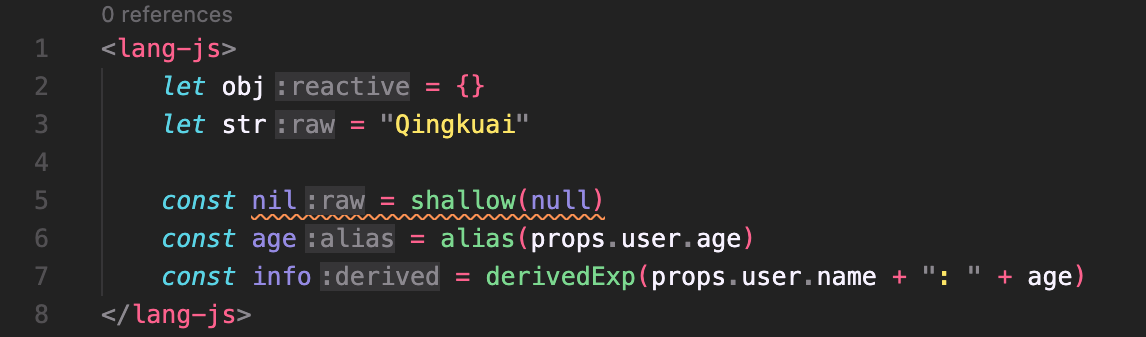
inlayHintReactiveStatus setting in the VS Code extension.
When hovering over an identifier in the top-level scope, the language server also shows the reactivity type inferred by the compiler in the tooltip:
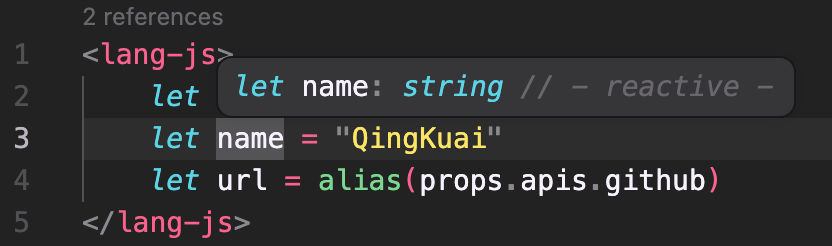
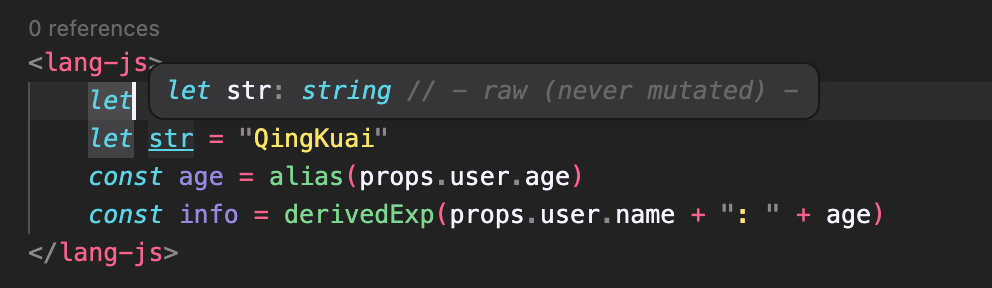
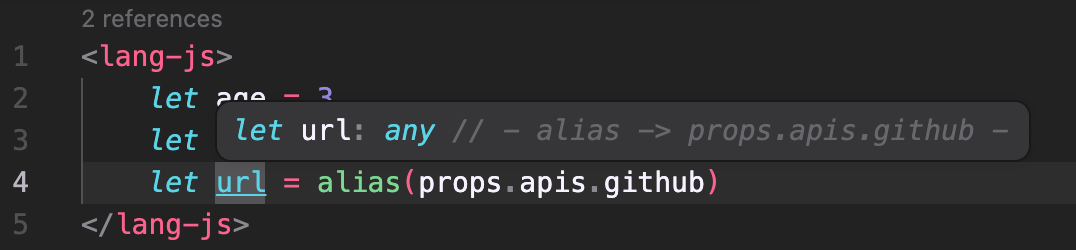
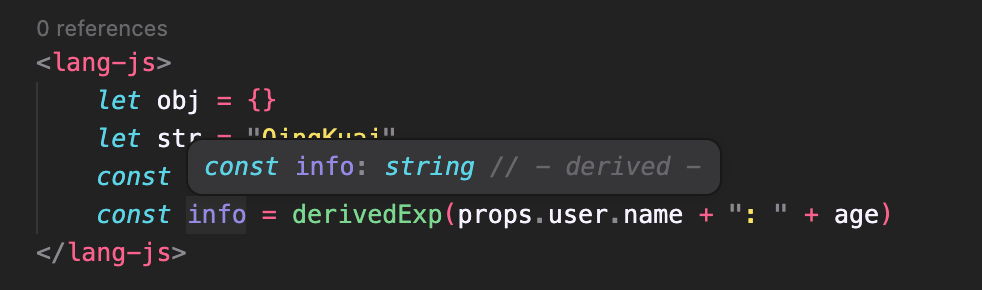
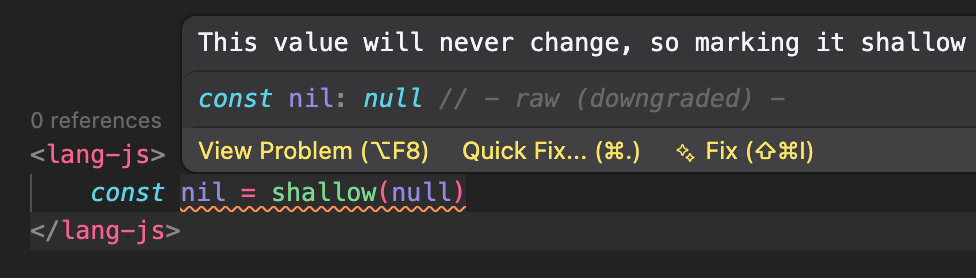
hoverHintReactiveStatus setting in the VS Code extension.